Harmonic Analysis of Chopin's Prelude #8
José Rodríguez Alvira
Measures 1 and 2
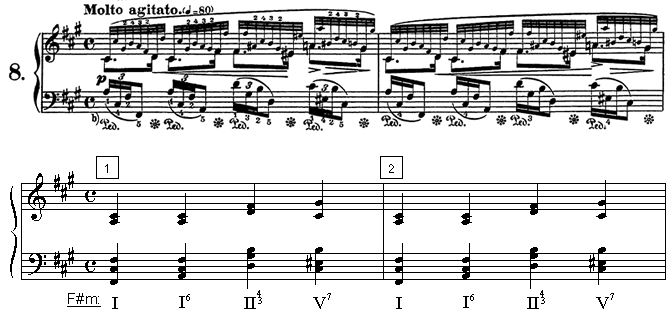
Harmonically, the first two measures are very simple. The second measure is a repetition of the first:
Recording courtesy of Robert Ståhlbrand and Piano Society
In this prelude, the main theme appears as an interior voice in the right hand. Most of the notes in the upper voice (32nd notes) reinforce the theme and harmony, but there are also several appoggiaturas (both diatonic and chromatic). Examples include the G♯ and B in the first and second beats, the A♯ and C♯ in the third beat, and the B♯ and D in the fourth beat.
